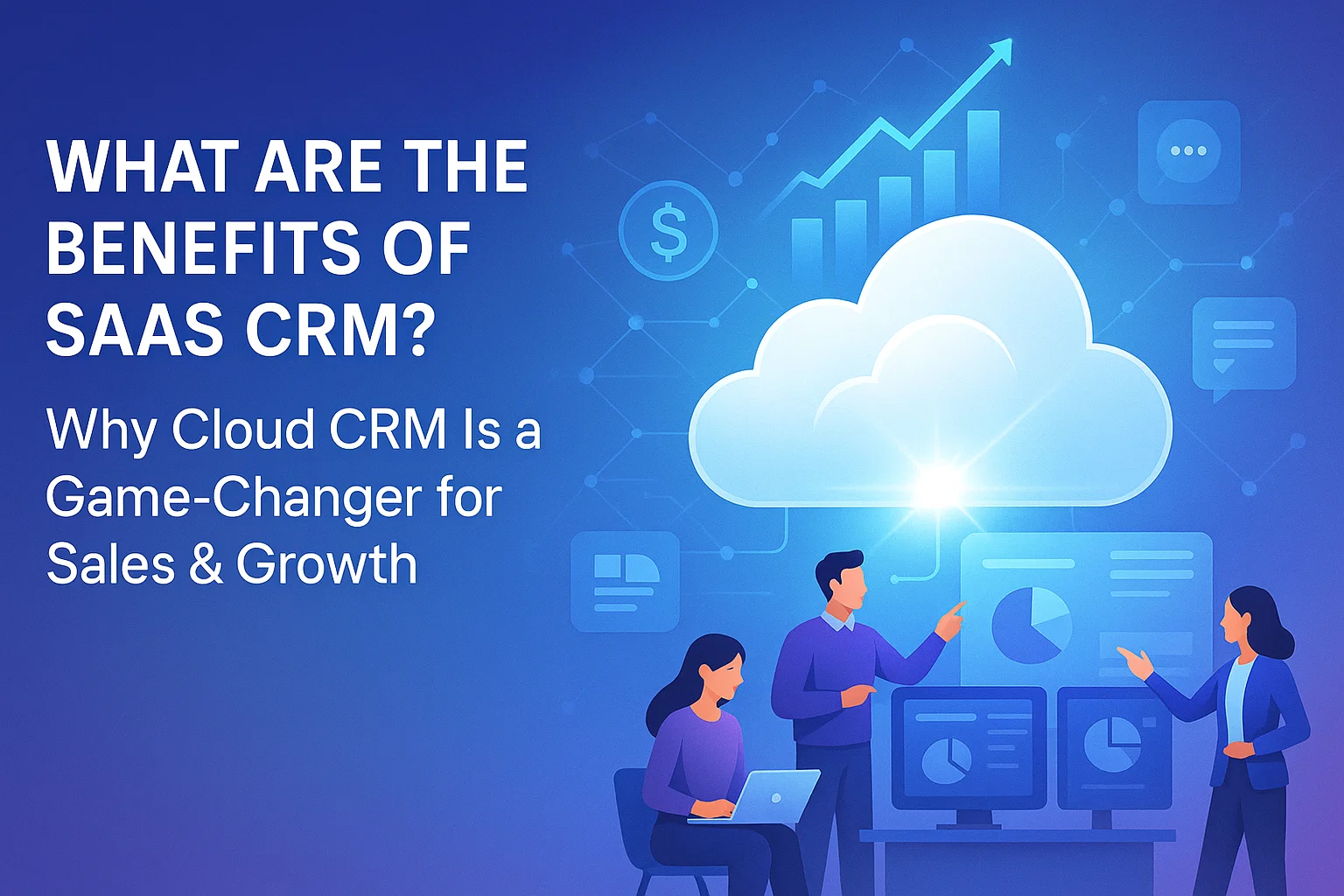
What Are the Benefits of SaaS CRM? Why Cloud CRM Is a Game-Changer for Sales & Growth
Introduction
Many businesses hesitate to invest in a robust CRM system because they fear the money may not deliver. Sales reps might assume a CRM means more admin work. But the truth is different. A modern SaaS CRM (software-as-a-service Customer Relationship Management) offers a powerful set of features to help teams sell more and work smarter.
Imagine this: you receive an email from a lead, the phone rings with a long-awaited deal, you’re scrambling to prepare a presentation — and you almost forget an important demo. Between Excel sheets, post-it notes, invoices, reports and chasing data, there’s little time left for actual selling. That’s exactly where a SaaS CRM comes in.
With the right system, you move away from chaos and admin overload. You get a platform where contact management, communication, pipeline tracking, quoting and closing are all handled in one place — letting you focus on what matters: sales and growth.
Why SaaS CRM Delivers Real Business Value

Centralize Client Information
How many times have you relied on outdated spreadsheets or lost notes for your sales process? With a SaaS CRM, you have one place to access full client profiles: lead source, interaction history, status in the pipeline — everything live, updated, accessible. This lets you personalize communication, act quickly and keep your team on the same page.
Timely Follow-Ups & Better Customer Relationships
Your clients aren’t just deals — they’re relationships. A SaaS CRM helps you deliver on what you promise: send the right email, make the right call, at the right time. According to one CRM statistics review, 74% of users say CRM gives improved access to customer data, reducing lost opportunities. Pipeline CRM+1
Improve Customer Retention
Acquiring new customers is up to five times more expensive than retaining existing ones. CRM tools help you nurture clients post-sale — capture interaction history, notes on preferences, automate check-ins and cross-sell or upsell when the time is right. Research shows companies with CRM experience growth in customer retention and satisfaction (e.g., 47% growth in one data set). Pipeline CRM
Identify and Fix Gaps in the Sales Process
For sales leaders, it’s vital to track what’s working and what’s not. SaaS CRM systems provide dashboards, pipelines, conversion analytics and activity tracking. Instead of sifting through spreadsheets, you get clear visuals showing where deals stall, where reps need support, and where processes can improve.
Align Sales & Marketing Teams
A CRM isn’t just for sales — it’s the glue between departments. When marketing and sales share data (lead source, campaign response, behaviour), ROI improves: businesses with aligned sales & marketing see 36% higher customer retention and 38% higher win rates. Good CRM systems enable that alignment.
Boost Productivity & Automation
With manual admin tasks out of the way, sales teams spend more time selling. SaaS CRMs offer automation of emails, follow-ups, reports, data entry and approvals. One source notes that adoption of CRM increases sales revenue by 21-30% for many companies. Pipeline CRM
Simplify Integration and Access
No more bouncing between spreadsheets, email, the calendar, the invoicing tool and support system — a modern SaaS CRM integrates with email marketing, lead-generation tools, accounting systems, help-desk platforms and more. And because it’s cloud-based, your team can access it from anywhere, on any device, without heavy infrastructure. Creatio
What Research Says: Gartner & Industry Insights
According to recent analysis: over 80% of new CRM implementations are SaaS-based, driven by lower cost and easier access. vtiger.com
Industry statistics also show dramatic benefits: a 300% increase in lead conversion rate and retention improvements of 47% have been reported after CRM adoption. Pipeline CRM
Those findings reinforce that SaaS CRM isn’t just a tool — it’s a strategic investment that can deliver measurable ROI when implemented and used properly.
SaaS CRM vs In-House CRM: Key Differences
When choosing a CRM, many consider two options: on-premise (in-house) or SaaS (cloud-based). Here’s how they compare:
-
Cost & Maintenance: On-premise requires large upfront investment in servers, software and IT staff. SaaS comes as a subscription and the vendor handles updates and security. Creatio
-
Deployment Speed: SaaS can be live in days or weeks; in-house can take months to build and deploy.
-
Accessibility & Scalability: SaaS is accessible anywhere, and scales as your business grows. In-house often lacks mobility and scalability.
-
Integration & Innovation: SaaS CRM vendors continuously innovate (AI, analytics, mobile), and integrate widely. On-premise systems often lag.
-
Best For: SMBs looking to grow quickly with minimal IT overhead tend to benefit most from SaaS CRM. Larger enterprises with heavy customisation might still consider on-premise.
How to Choose and Get the Most from a SaaS CRM
Here are practical steps to ensure you pick the right CRM and make it work:
-
Define your business goals: Are you focused on increasing leads, improving pipeline visibility, boosting retention or aligning teams?
-
Ensure usability and adoption: Choose a CRM with intuitive UI, mobile apps and onboarding/training support.
-
Check integrations: Your CRM should connect with marketing platforms, accounting, support and other key systems.
-
Prioritise data and security: Look for vendors with compliance certifications, data encryption, and regular backups.
-
Measure ROI: Track metrics like deal conversion, time to close, customer retention, revenue growth pre and post-CRM.
-
Ensure ongoing support & upgrades: With SaaS CRM, vendor updates should be automatic and innovations continuous.
-
Drive adoption across teams: It’s not just a sales tool. Get marketing, support and management onboard for full benefit.
Common Challenges (And Solutions)
-
Resistance from users: Provide training, highlight wins, keep the UI simple.
-
Poor data quality: Clean data before import, enforce rules and regular audits.
-
Lack of integration: Prioritise vendors with open APIs and pre-built connectors.
-
Under-utilisation: Set KPIs, run dashboards, give visibility to team performance.
Conclusion
A SaaS CRM system is far more than a contact database — it’s a command centre for your sales, marketing and customer service operations. When chosen and used properly, the benefits are undeniable: higher productivity, better customer relationships, improved alignment, faster ROI and sustained growth.
From Gartner’s research to industry statistics showing conversion lifts of up to 300%, the evidence is clear — SaaS CRM is not just an option, it’s a business essential for 2025 and beyond.
Ready to stop chasing spreadsheets and start closing deals? A modern SaaS CRM could be the catalyst your team needs.