n a major move on 30 June 2025, the Italian government approved the draft of its latest flow-decree — the Decreto Flussi for the period 2026-2028. This policy outlines how many non-EU workers will be allowed into Italy for work over the next three years, across seasonal and non-seasonal jobs. Arletti Partners+2Mazzeschi+2
What are the quotas?
-
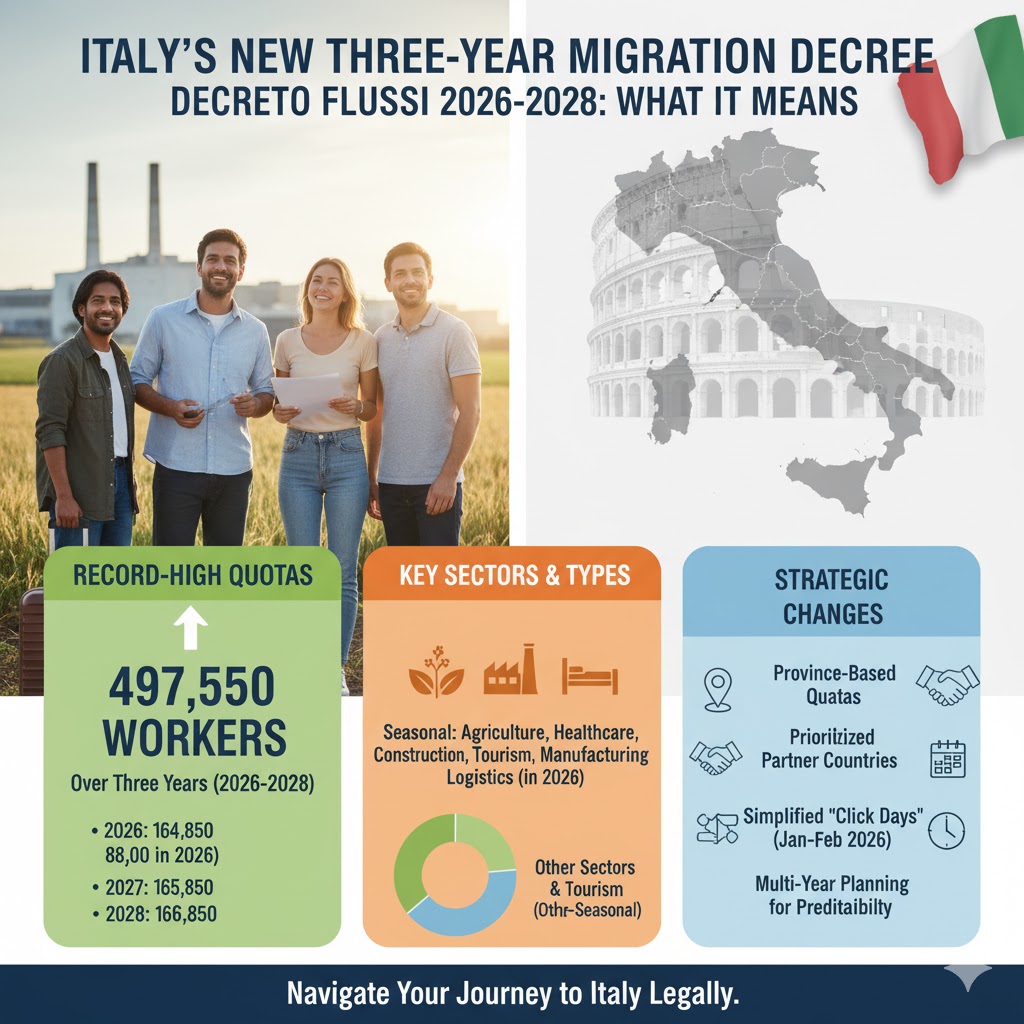
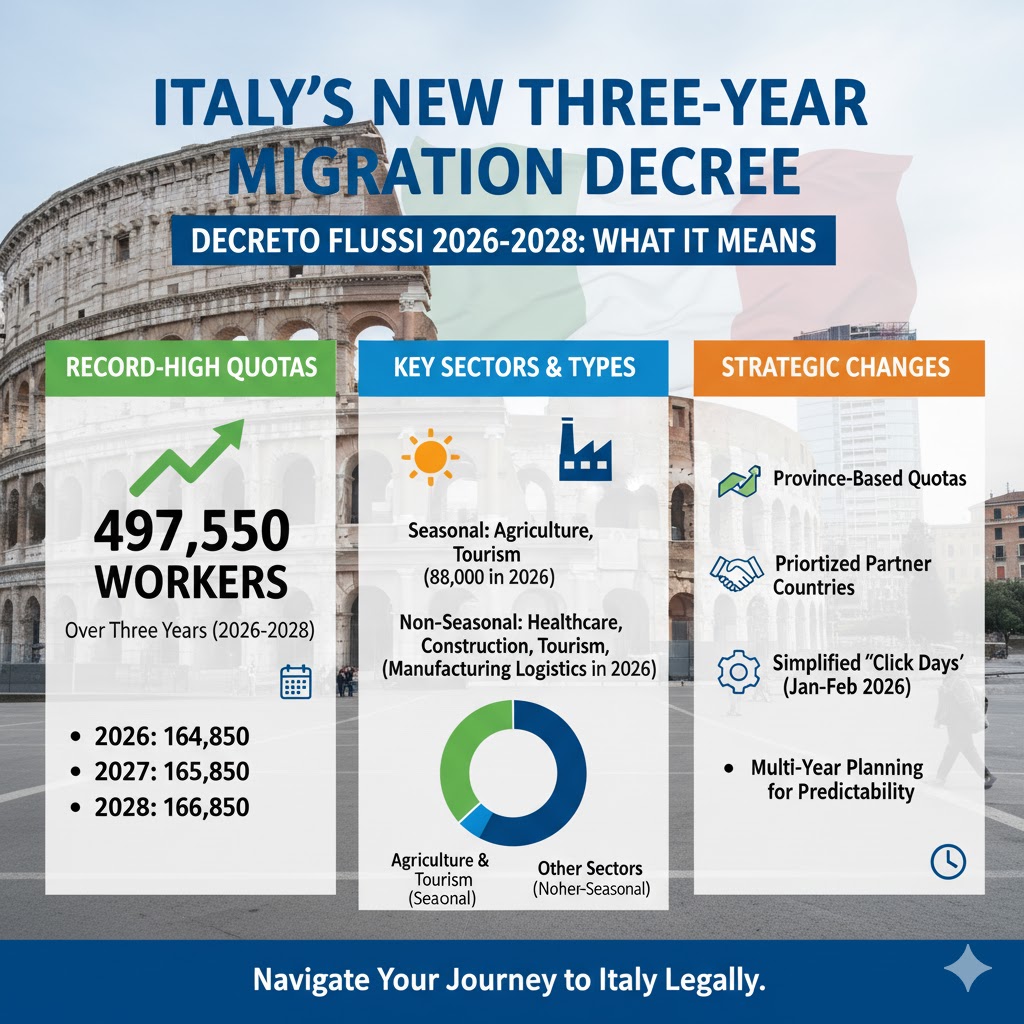
Total number of entries planned for 2026-2028: 497,550 workers. Schengen Visa News+2Visa Guru+2
-
Breakdown:
-
Non-seasonal/subordinate & self-employment: 230,550 spots. Schengen Visa News
-
Seasonal work (agriculture, tourism): 267,000 spots. Schengen Visa News+1
-
-
Year-by-year:
-
2026: ~164,850 entries. Arletti Partners+1
-
2027 and 2028: slightly higher each year. Schengen Visa News+1
-
What’s new in this decree?
-
Territorial distribution: For the first time, the quotas will be divided by province within ten days after application deadlines. The aim: better match local labour market needs. Yourwaytoitaly+1
-
Click-day system maintained: The “click-day” mechanism (where applications open on specific days at specific times) will continue, though the government hinted reforms might come. Yourwaytoitaly+1
-
Dual aim: The plan is not only about filling jobs — it is designed to combat irregular migration and reduce undeclared work, by offering more predictable legal entry. Italy Law Firms
Why is Italy doing this?
Italy faces demographic and labour-market challenges:
-
An aging population and low birthrate mean fewer domestic workers entering many sectors. Reuters
-
Key sectors such as agriculture, tourism, construction, and care work are struggling with labour shortages and depend on foreign workers.
-
By tying quotas to actual employer demand and past permit-applications, the government hopes to make legal migration more systematic. Arletti Partners+1
Who is eligible?
While the decree covers large numbers, it’s important to note some of the detailed eligibility and process points (based on earlier flow-decrees, similar rules apply):
-
Jobs may be seasonal (like harvest-workers, hotel/tourism staff) or non-seasonal/subordinate (regular employment) or self-employment.
-
Block quotas exist for non-EU nationals — meaning those nationals must apply in the timeframe, often through employer sponsorship.
-
Outside the quota: some categories (e.g., highly skilled persons, intra-company transferees, EU long-term residents) may enter outside the annual quotas. MFAIC+1
-
Employers usually need to register, certify worker unavailability in Italy, and apply via the designated ALI portal; the “click-day” means timing is critical. Arletti Partners+1
Pros & Cons
Pros
-
Predictability: A three-year plan gives employers and prospective workers clearer horizon.
-
Scale: Nearly 500,000 openings offer major opportunity compared with previous quotas.
-
Alignment: Matches labour market needs in Italy, reduces pressure on irregular channels.
Cons / Challenges
-
Competition: With so many applicants, the “click-day” system remains a bottleneck and can feel like a lottery.
-
Bureaucracy: Despite reforms, procedures remain complex (employer certifications, residence permits, etc.).
-
Local matching: Even with provincial quotas, job-worker fit, language, relocation still pose real issues.
What this means for you (as a worker or employer)
-
If you are a non-EU worker seeking employment in Italy: Keep an eye on the ALI portal, prepare your documentation, align your skills with target sectors (agriculture, tourism, care, construction).
-
If you are an employer in Italy: Plan ahead for sourcing foreign workers, factor timing (click-day), and align your job offers with eligible quota categories.
-
For both: Understand that just because a quota exists doesn’t guarantee success — you need job offer, employer compliance, timely application.
Key Takeaways
-
Italy is shifting to a predictable, three-year migration strategy via the Decreto Flussi 2026-2028 (497,550 quotas).
-
The plan balances short-term (seasonal) labour needs with longer-term non-seasonal employment.
-
While the system remains competitive and procedural, it opens major opportunities for legal migration to Italy.